AHK-Cu
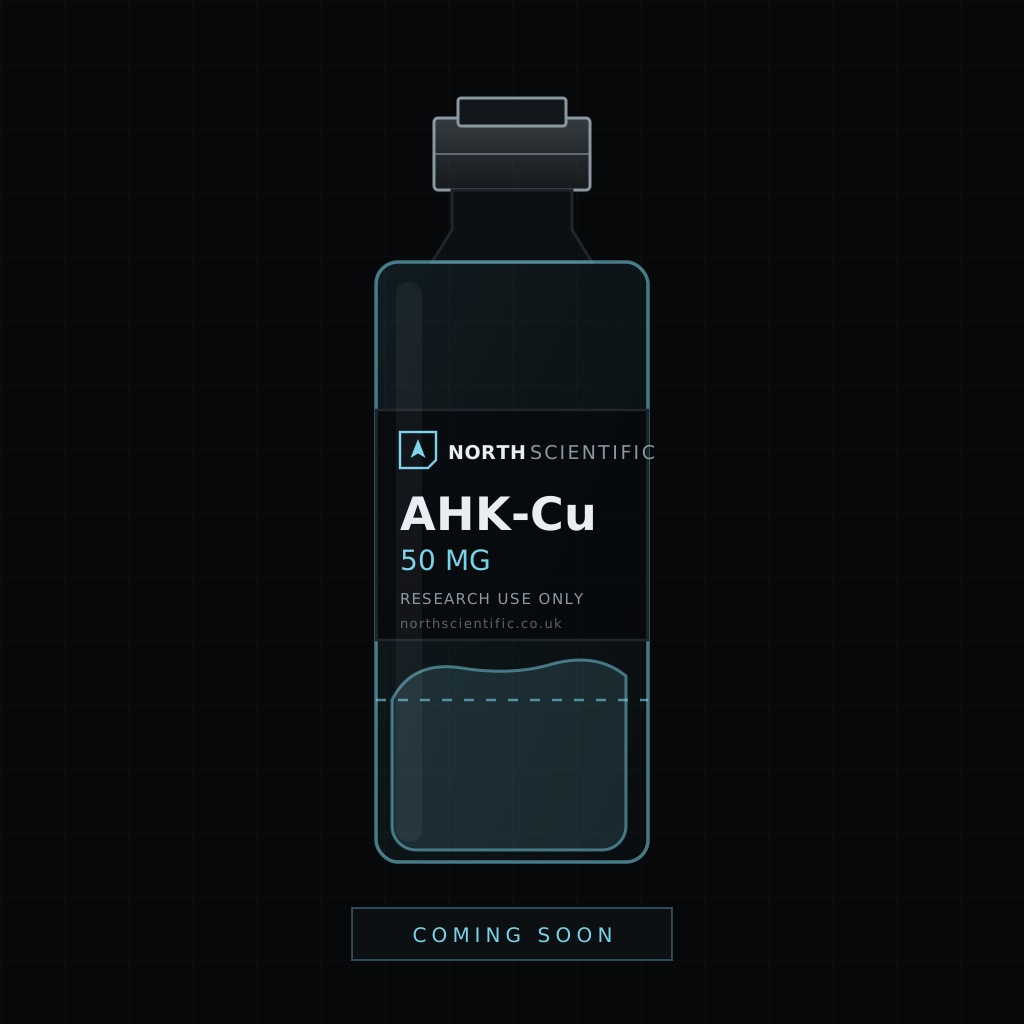
Copper peptide · 50 mg · lyophilised · coming soon. Research use only — not for human consumption.
Copper peptide · 50 mg · lyophilised · coming soon. Research use only — not for human consumption.
One email when AHK-Cu goes on sale · no marketing list · UK delivery included on every order · Pay by card
Copper tripeptide: Ala-His-Lys complexed with copper(II). Sibling of GHK-Cu. Planned as a 50 mg listing to the same standard as the rest of the catalogue: lyophilised powder in a crimp-sealed glass vial, held in UK stock, dispatched tracked on working days with UK delivery included in the price.
AHK-Cu is the tripeptide L-alanyl-L-histidyl-L-lysine complexed one-to-one with copper(II). It is the structural sibling of the GHK-Cu already in the catalogue: the two differ only in the N-terminal residue, alanine here in place of glycine, with the histidine and lysine, and the copper, the same. The free tripeptide has the formula C15H26N6O4 and a molar mass of approximately 354.4 g/mol; the copper complex is C15H24CuN6O4 at approximately 415.9 g/mol. Two CAS numbers circulate for the complex, one for the neutral complex and one for a hydrochloride form, so we give the formulae rather than a single registry number.
The planned listing is 50 mg fill weight as lyophilised powder in a crimp-sealed glass vial, matching the GHK-Cu format. Copper(II)–peptide complexes are coloured, so the cake is typically blue to violet rather than white. Fill weight is the mass of powder in the vial; the share that is complex, counter-ion or water is a separate matter, explained in peptide purity versus net peptide content.
AHK-Cu is not yet on sale. It is listed so that laboratories in the United Kingdom can see what is planned and register interest; when it is in UK stock we send one email to say so, with the price, and nothing else. When it goes on sale it will be supplied on the same terms as every other material here: the price shown will be the total payable with UK delivery included, dispatched by Royal Mail Tracked 24 in unbranded packaging, with an order placed before 14:00 on a working day leaving that day where stock allows. Dispatch detail is on the shipping page. We supply research organisations, educational and commercial laboratories, and individuals purchasing for legitimate research.
AHK-Cu will be supplied lyophilised, for storage at −20 °C protected from light. Like GHK-Cu it is hygroscopic, so the practical points are to keep the crimp seal intact and to let the vial reach room temperature before opening, so that moisture does not condense on a cold cake. The tripeptide has no oxidisable or deamidating side chains; the copper is coordinated by the histidine imidazole and the peptide backbone, and that coordination, not the peptide bonds, is what water and pH changes act on once in solution. See lyophilised peptide storage and stability.
AHK-Cu is listed by NorthScientific strictly for laboratory research use. It is not a licensed medicine and has not been evaluated or approved by the MHRA; it is not a food, cosmetic or supplement; and it is not for human or veterinary consumption in any form. We provide no dosing, protocol or outcome guidance of any kind, and nothing on this page, in our guides or in correspondence should be read as such.
No. NorthScientific lists AHK-Cu for laboratory research only; it is not for human or veterinary consumption in any form. We give no dosing or protocol guidance, and nothing on this page should be read as such.
We list it now so that laboratories can register interest, and we email once, when it is in UK stock and on sale. No date is promised: it goes on sale when supply meets the same standard as the rest of the catalogue, and the price is published then.
By the first residue: alanine (A) in AHK-Cu, glycine (G) in GHK-Cu. The histidine, the lysine and the copper(II) are the same, so the two are listed as separate materials with different formulae and masses.
Because copper(II) complexes absorb visible light. A blue to violet cake is the expected appearance of a copper–peptide complex, as it is for GHK-Cu, and is not a sign of anything wrong.
Not necessarily. The planned 50 mg is the fill weight of lyophilised powder in the vial; how much is complex, how much counter-ion and how much residual water is a separate figure. We do not publish an analysis for this material, so read the figure as fill weight.
Related reading: Purity vs net peptide content · Lyophilised peptide storage · How research peptides are made · all guides