KPV
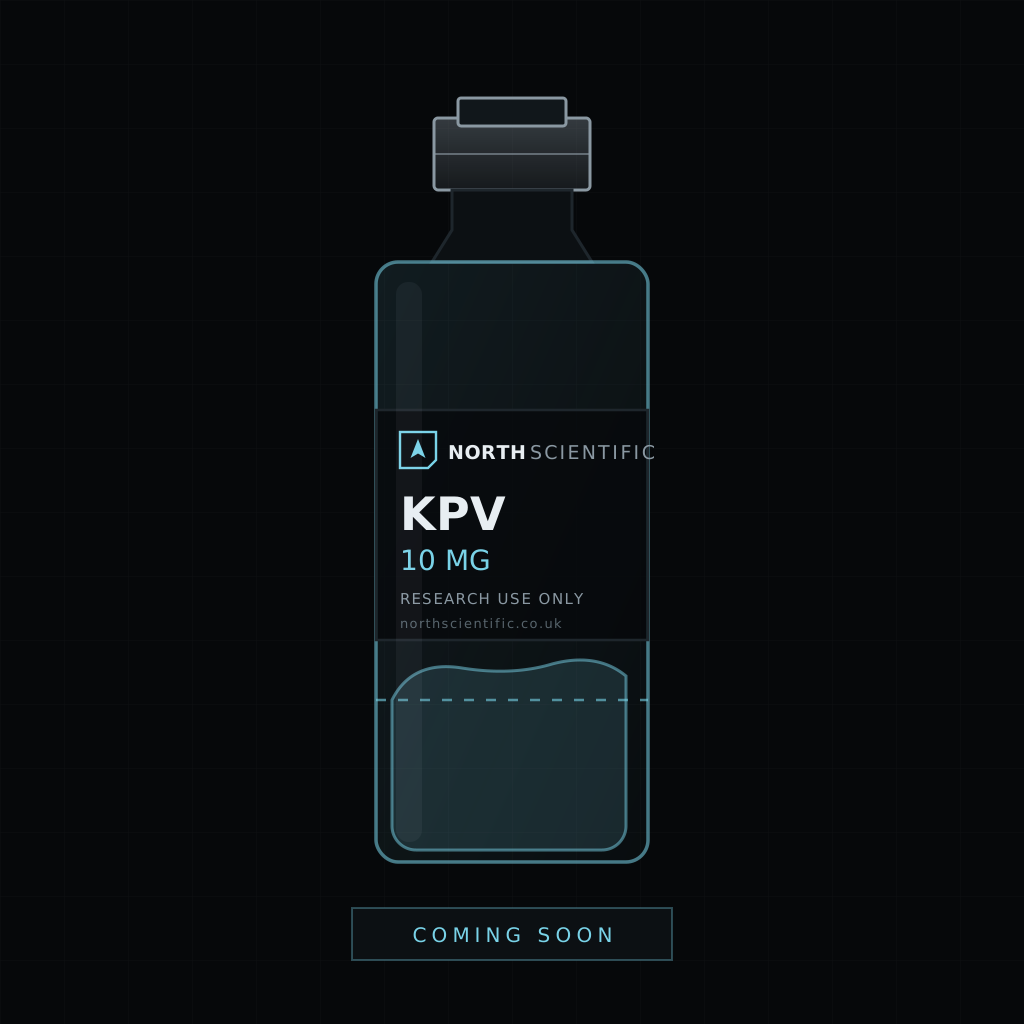
Single peptide · 10 mg · lyophilised · coming soon. Research use only — not for human consumption.
Single peptide · 10 mg · lyophilised · coming soon. Research use only — not for human consumption.
One email when KPV goes on sale · no marketing list · UK delivery included on every order · Pay by card
Synthetic tripeptide Lys-Pro-Val, the C-terminal residues 11–13 of α-MSH. Planned as a 10 mg listing to the same standard as the rest of the catalogue: lyophilised powder in a crimp-sealed glass vial, held in UK stock, dispatched tracked on working days with UK delivery included in the price.
KPV is a synthetic tripeptide: three amino acid residues, Lys-Pro-Val, named by their one-letter codes. The sequence corresponds to residues 11 to 13, the C-terminal tripeptide, of α-melanocyte-stimulating hormone (α-MSH), which is why it is also catalogued in the literature as MSH(11–13); the material we plan to list is made by chemical synthesis and is not that hormone. Its identifiers are CAS 67727-97-3, molecular formula C16H30N4O4 and a molar mass of approximately 342.4 g/mol for the free peptide.
The planned listing is 10 mg fill weight as lyophilised powder in a crimp-sealed glass vial. For a molecule this small the counter-ion and residual water make up a proportionally larger share of the fill weight than they do for a long peptide, which is why the fill weight on the label and net peptide content are reported as different figures; see peptide purity versus net peptide content.
KPV is not yet on sale. It is listed so that laboratories in the United Kingdom can see what is planned and register interest; when it is in UK stock we send one email to say so, with the price, and nothing else. When it goes on sale it will be supplied on the same terms as every other material here: the price shown will be the total payable with UK delivery included, dispatched by Royal Mail Tracked 24 in unbranded packaging, with an order placed before 14:00 on a working day leaving that day where stock allows. Dispatch detail is on the shipping page. We supply research organisations, educational and commercial laboratories, and individuals purchasing for legitimate research.
KPV will be supplied lyophilised, for storage at −20 °C protected from light. The sequence has no methionine, cysteine or tryptophan and no asparagine or glutamine, so neither oxidation nor deamidation is a pathway; the lysine side chain is basic and the molecule is hygroscopic as a salt, so keeping the vial sealed and letting it reach room temperature before opening are the practical points. The general reasoning is in lyophilised peptide storage and stability.
KPV is listed by NorthScientific strictly for laboratory research use. It is not a licensed medicine and has not been evaluated or approved by the MHRA; it is not a food, cosmetic or supplement; and it is not for human or veterinary consumption in any form. We provide no dosing, protocol or outcome guidance of any kind, and nothing on this page, in our guides or in correspondence should be read as such.
No. NorthScientific lists KPV for laboratory research only; it is not for human or veterinary consumption in any form. We give no dosing or protocol guidance, and nothing on this page should be read as such.
We list it now so that laboratories can register interest, and we email once, when it is in UK stock and on sale. No date is promised: it goes on sale when supply meets the same standard as the rest of the catalogue, and the price is published then.
The one-letter codes of its three residues: K for lysine, P for proline, V for valine. The full name is Lys-Pro-Val.
It identifies the origin of the sequence: Lys-Pro-Val is the C-terminal tripeptide, residues 11 to 13, of α-melanocyte-stimulating hormone. That is a statement of sequence identity; the material is synthetic.
Not necessarily. The planned 10 mg is the fill weight of lyophilised powder in the vial; the peptide share depends on salt form and residual moisture. We do not publish an analysis for this material, so read the figure as fill weight.
Related reading: Purity vs net peptide content · Lyophilised peptide storage · How research peptides are made · all guides